Time Might Not Exist. Physics Is Starting to Admit It
The new idea breakthrough in physics that may remove time from reality. A journey from flowing time to a universe that may be timeless.
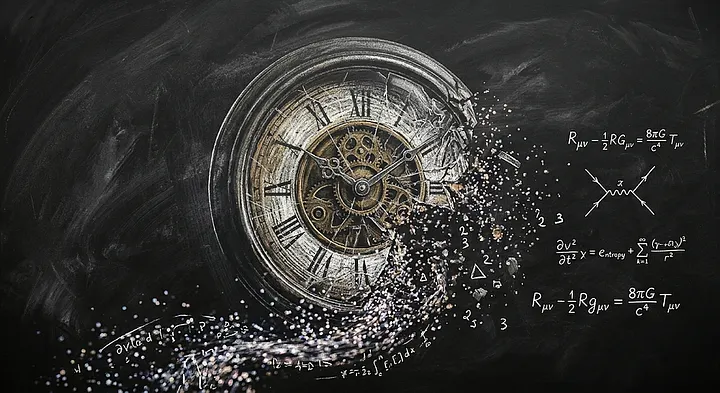
Have we ever been concerned about time?
Every second we live through it — our heartbeat, our thoughts, the slow drift from morning to night. It feels constant, Reliable. Almost invisible in how time perfectly works.
But physics has a habit of breaking things that feel obvious.
The deeper we look into layers of reality, the stranger it gets. Space bends. Particles behave like waves. Cause and effect start to blur.
And somewhere along that descent, something even more unsettling begins to happen — Time starts to disappear. No slowdown. No stretch. Just disappear.
But;
What if time isn’t a fundamental part of the universe at all? What if it’s not built into reality — but emerges from something deeper we barely understand?
Because the closer physicists get to the foundations of the universe, the less time seems to belong there.
Newtonian time
Imagine two people — one on Earth, one on a distant planet — both watching a clock tick.
Different places. Different motions. Different worlds.
Yet for centuries, physics assumed something bold: They are both living through the same time.
This was the universe of Isaac Newton.
In his view, time didn’t belong to objects, motion, or space. It existed on its own — flowing steadily, uniformly, untouched by anything happening inside the universe.
Planets could orbit, apples could fall, stars could explode, but time would keep ticking the same way everywhere and for everyone.
It was the ultimate background — like an invisible stage on which the entire universe performed.
And because this idea worked so well — predicting motion with incredible accuracy — no one had a reason to question it.
Time wasn’t a mystery.
It was a given. But that quiet certainty was about to collapse.
Einstein’s time
Then something strange happened.
Two perfectly identical clocks — one on Earth, one moving fast in space — no longer agree.
Not because one was broken but because time itself had changed.
This was the universe of Albert Einstein.
He didn’t just tweak Newton’s ideas — he overturned them. Time was no longer this invisible, untouchable background.
It became something physical. Something that could stretch, slow down, or even bend under the influence of motion and gravity.
According to Einstein, time was something different for everyone, which was something dependent on certain conditions, like:
- Move faster, and your time slows.
- Get closer to a massive object, and your time drifts differently from someone far away.
There is no single universal clock anymore.
And more than that, it fused with space itself, forming what we now call Spacetime. Not a stage, but part of the play. Not passive, but dynamic.
It was a radical shift. But look closely, and a subtle assumption still survives:
Even in Einstein’s universe, time is still there. It is continuous, flowing and real. It bends — but it never disappears.
Quantum time
Just when time started to feel physical — something we could stretch and bend — quantum physics quietly did something unexpected.
Quantum physics ignored it.
Deep inside atoms, where reality becomes probabilistic and strange, time doesn’t behave like a physical quantity at all.
It doesn’t fluctuate. It doesn’t become uncertain. It doesn’t get entangled with anything. It just sits there.
In Erwin Schrödinger’s equations, time plays a surprisingly unexciting role.
It’s not something you measure like position or energy. It’s not part of the system.
It’s just a background parameter — ticking away, unchanged, almost like Newton never left.
That should feel wrong.
Because by now, we’ve already learned from Einstein that time is dynamic — that it bends, slows, responds to the universe.
But here, in the most fundamental theory of matter, that entire idea seems to vanish. Two of our best theories — General relativity and quantum mechanics — are telling completely different stories.
- One says time is a physical, flexible part of reality.
- The other treats it as a fixed, invisible backdrop.
Both theories work and are incredibly accurate. And yet, at the deepest level, they cannot both be true.
This is where the real crack appears — not in time itself, but in our understanding of it.
At this point, you might expect the story to resolve. But, no.
Maybe a deeper theory will finally settle everything — make time both quantum and flexible, something that fits neatly into a single framework.
Instead, something far more unsettling happens.
Time doesn’t get fixed. It vanishes.
When physicists tried to combine quantum mechanics with gravity, they arrived at an equation that was supposed to describe the entire universe at once — the Wheeler–DeWitt equation.
This wasn’t just another formula. It was meant to be the most fundamental description of reality itself.
But when they looked closely, they found something shocking. There was no time in it. Not hidden or modified. Just absent.
According to this equation, the universe doesn’t evolve.
It simply is with no past, no future and no flow. A complete, frozen description of everything that exists.
If that sounds impossible, that’s because it clashes directly with everything we experience. We remember the past. We anticipate the future. And we feel time moving.
And yet, at the deepest level we can currently describe, the laws don’t seem to care about any of that.
It’s as if time — the very thing we’ve trusted from the beginning — was never part of the fundamental picture at all.
Let that sink in.
Because from here on, the question isn’t “how does time work?”
It’s whether time exists in the first place.
Modern ideas for time
So what do physicists do when time disappears from their equations?
They don’t give up on time. They try to rebuild it — from scratch.
Time from Entanglement
One of the most intriguing ideas comes from Carlo Rovelli. Instead of asking “What is time?”, he flips the question:
What if time isn’t built into the universe at all — but emerges from how physical systems relate and change with respect to each other?
Think about it.
We never actually measure time directly. We compare changes:
- The Earth rotates relative to the Sun.
- Your thoughts shift relative to your memories.
- A change in one thing becomes meaningful only when compared to something else.
Time, in this view, isn’t a universal flow. It’s a network of comparisons between systems.
No master clock ticking for the entire universe. No single timeline everyone shares.
Only interactions. Only correlations.
In quantum physics, this idea goes deeper. When systems become entangled, their states are linked.
One system can effectively act as a “clock” for another — not because time exists independently, but because change is being tracked internally.
Time, then, is not fundamental.
It’s something that appears when parts of the universe relate to each other in the right way. And that changes everything.
Because if time is emergent, then the universe at its core isn’t evolving in time — It’s a structure from which time itself arises.
Thermal/Entropic time
Even if time disappears from the deepest equations, something stubborn remains in our everyday world.
Things change in one direction.
Always, ice melts, smoke spreads, and a broken glass never reassembles itself.
We don’t need a clock to notice this. We just need to watch.
Long before quantum gravity, physicists like Ludwig Boltzmann realised something profound: the direction of time seems tied to entropy — a measure of disorder.
Systems naturally move from ordered states to more disordered ones. Not because a law forces them forward in time, but because there are simply more ways for things to be messy than organised.
This is where time starts to look different again.
Not as a fundamental ingredient, but as a statistical effect.
The “arrow” of time — the reason past and future feel different — may come from the way information spreads and becomes harder to track.
As particles interact, details get scrambled, correlations disperse, and the system loses its neat structure.
In that sense, time isn’t something ticking underneath reality.
It’s something that emerges from the flow of information.
And that’s a radical shift.
Because now, time doesn’t come from the basic laws themselves — it comes from how large collections of particles behave together.
From probability. From statistics. From the overwhelming tendency of the universe to move toward disorder.
Which means the direction of time might not be written into the fabric of reality —
It might be written into the way information gets lost.
Time without time
All of this might sound like philosophy — interesting, but untouchable.
But here’s the twist: Physicists have started testing these ideas in the lab. Not with clocks on walls, but with quantum systems themselves.
Imagine two tiny quantum systems — say, two particles. One is chosen to act as a “clock.” The other is the system we want to study. It’s like a primary system and reference system.
There is no external time ticking in the background. No universal clock guides the experiment. And yet, something remarkable happens.
As one system changes, the other can be described relative to it — as if time is flowing between them.
Not because time exists independently. But because one system is tracking the change of another.
This is the essence of what physicists call “time without time.”
In these setups, time isn’t fed into the system from outside. It’s built from within, emerging from correlations between quantum states.
Experiments inspired by ideas from researchers like Don Page and William Wootters show that a sense of evolution can arise even when the overall system is described by a timeless equation.
Step back, and this is wild.
You can have a universe that, globally, doesn’t evolve at all… and yet, internally, parts of it experience change — as if time is passing.
This is no longer just a philosophical escape route. It’s a testable idea.
And slowly, experiment by experiment, physics is beginning to probe whether time is truly fundamental — or just something that appears when the universe looks at itself from the inside.
So where does this leave us?
Not with answers but with consequences.
If time is not fundamental — if it doesn’t exist at the deepest level of reality — then some of our most basic assumptions begin to unravel.
There may be no universal “before” and “after.” No single timeline the universe is following. No global clock marking the passage of events.
Instead, the universe could be something far stranger:
A complete structure. Already there. Not evolving — just existing.
What we experience as change, as flow, as the movement from past to future… might not be built into reality itself.
It could be a perspective, emerging from how we, as observers inside the system, track and compare states.
In other words, the universe might not be moving through time. We might be moving through the universe.
But there’s another possibility.
All of this confusion — this clash between relativity, quantum mechanics, and timeless equations — might be a sign that we’re missing something deeper.
A new framework. A theory of quantum gravity that doesn’t remove time, but redefines it completely.
Not Newton’s absolute time. Not Einstein’s flexible time. Something else entirely. And right now, we don’t know which path reality takes. That’s the real tension.
Because if physics gets this wrong, it’s not just a detail we’ve misunderstood.
It’s the stage on which every physical process unfolds.
And we’re not even sure the stage exists.